
Identify and recognize wallpaper in your image. Our image recognition tool uses machine learning and will also identify other objects found in your image. You can also select and vary the detection confidence and the number of objects that you want to detect.
Use AI to identify objects in your image. Vary the detection confidence and the number of objects that you want to detect below.

Click image to enlarge
The word and object ‘wallpaper’ has a frequency score of 3.33 out of 7, which means that it is not a very popular word, but is used quite frequently in English.
According to the English dictionary, some meanings of ‘wallpaper’ include:
- cover with wallpaper (verb)
- a decorative paper for the walls of rooms (noun)
Benefits of OCR for Modern Businesses
Why OCR matters in daily business operations
Optical character recognition, often called OCR, is the process of turning text inside an image into readable digital text. Businesses use OCR to capture information from scanned files, photos, invoices, forms, receipts, labels, and many other documents. This matters because large amounts of business information still arrive as images or paper records, even in companies that use modern software. When text is locked inside an image, it cannot be searched, copied, or processed easily. OCR solves this problem by making the text usable. It helps employees save time, reduce manual typing, and improve access to information across teams. For example, a company can scan printed contracts and quickly find keywords later, or it can extract text from receipts for accounting. This reduces repetitive work and supports faster decisions. OCR is also useful for organizations that need to organize archived documents without entering every line by hand. As more companies move toward digital workflows, OCR becomes a practical bridge between physical documents and digital systems. It supports better record keeping, easier information sharing, and more efficient data handling. For businesses that already use image recognition tools, OCR is a natural extension because it adds the ability to read text from visual content, not just identify objects or faces. This makes OCR an important part of modern document processing.
Key business benefits of OCR technology
The main benefit of OCR is efficiency. Manual data entry takes time and often leads to mistakes, especially when teams process large numbers of documents every day. OCR can help reduce this burden by extracting text automatically, which supports faster workflows and lower operational costs. Another major benefit is searchability. Once text is converted into machine-readable format, businesses can index documents and search them in seconds. This improves productivity in departments such as finance, legal, customer service, and human resources. OCR also supports better accuracy when compared with repeated manual typing, although results still depend on image quality and the clarity of the original document. In addition, OCR can help with compliance and record management by making files easier to store, classify, and retrieve. Companies that handle invoices can extract payment details more quickly. Businesses that process application forms can move information into internal systems with less delay. OCR can also improve customer experience. When staff can access information faster, they can respond more quickly to requests and resolve issues sooner. Another advantage is scalability. As document volume grows, OCR helps businesses handle more work without increasing manual effort at the same rate. This is especially useful for organizations that receive many scanned documents, mobile uploads, or image-based records. In a competitive market, tools that save time and improve workflow can have a direct impact on productivity and service quality.
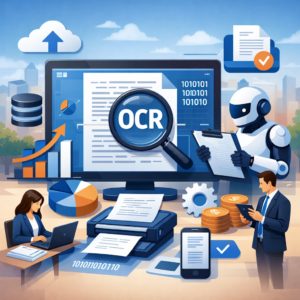
Common OCR use cases across industries
OCR is used in many industries because text appears in many types of images and documents. In finance, OCR helps capture details from invoices, receipts, bank records, and expense documents. In healthcare, it can support document digitization, patient form processing, and easier access to printed records, while still requiring careful attention to privacy and data handling rules. In retail and ecommerce, OCR can extract product information, shipping labels, and printed order details. In logistics, it can help read package labels, delivery notes, and inventory records. Legal teams may use OCR to digitize contracts and case files so that large document collections can be searched more easily. In education, OCR can help convert printed learning materials into editable text, which supports both administration and accessibility efforts. Human resources departments can use OCR when processing resumes, applications, and employee documents. OCR is also valuable for content management, where businesses need to organize scanned reports, brochures, forms, or image-based PDFs. For online services, OCR can improve user experience by allowing people to upload a document image and extract the text quickly. This is especially useful in platforms that already work with AI image analysis. By combining OCR with broader image recognition, businesses can gain more value from uploaded images, such as identifying document types and reading the text they contain. This broader capability can support automation in many daily tasks.
How OCR supports digital transformation
Digital transformation is not only about adopting new software. It is also about making information easier to use across the business. OCR supports this goal by unlocking text from visual documents and moving it into digital workflows. Once text becomes machine-readable, it can be searched, analyzed, categorized, and sent to other systems. This creates opportunities for automation and better decision-making. For example, OCR can be part of a document pipeline where files are uploaded, text is extracted, and the results are reviewed or stored automatically. This helps reduce delays and makes information more available to teams that need it. OCR also supports remote work because digital documents are easier to access than paper files stored in one location. It can improve collaboration by allowing teams to share searchable records instead of scanned images with hidden text. At the same time, businesses should understand that OCR quality depends on factors such as resolution, lighting, layout, and handwriting complexity. Clean, clear images usually produce better results than low-quality scans. For this reason, OCR works best when paired with good input practices and review steps for important documents. Even with these limits, OCR remains a valuable tool for modern organizations that want to reduce manual work and improve document handling. As companies continue to rely on AI tools for image analysis, OCR will remain an important feature for turning visual information into practical business value.
Learn more
- Image Recognition Overview
- What is Machine Learning?
- Top 5 Uses of Image Recognition
- Are Machines becoming Smarter than Humans?
- Rising Popularity of Image Recognition
- Image Recognition Trends
- Prevent Crime and Improve Security with Facial Recognition
- Image Recognition in Medical Use
- Image Recognition Software on Cloud Platforms
- Image Recognition is Transforming Business
- Facial Recognition for Brand Awareness
- Image Recognition on Facebook
- Future of Image Recognition
- How Image Recognition is Changing Online Shopping
- How Image Recognition is Improving Online Security
- Image Recognition for Environmental Protection
- How Image Recognition is Enhancing Customer Experience
- How Image Recognition is Enhancing Education
- How Image Recognition Supports Transportation Systems
- How Image Recognition is Streamlining Manufacturing Processes
- How Image Recognition is Helping Agriculture Thrive
- Understanding How Image Recognition Improves Accessibility
- How Image Recognition is Simplifying Everyday Life
- How to Choose Image Recognition Software
- How Image Recognition Helps Content Moderation
- How Image Recognition Works Step by Step
- Image Recognition in Smart Cities
- Image Recognition and Data Privacy
- Benefits of OCR for Modern Businesses