
Identify and recognize smell in your image. Our image recognition tool uses machine learning and will also identify other objects found in your image. You can also select and vary the detection confidence and the number of objects that you want to detect.
Use AI to identify objects in your image. Vary the detection confidence and the number of objects that you want to detect below.

Click image to enlarge
The word and object ‘smell’ has a frequency score of 4.96 out of 7, which means that it is a pretty popular word.
According to the English dictionary, some meanings of ‘smell’ include:
- any property detected by the olfactory system (noun)
- the general atmosphere of a place or situation and the effect that it has on people (noun)
- the faculty that enables us to distinguish scents (noun)
- the act of perceiving the odor of something (noun)
- have an element suggestive (of something) (verb)
- the sensation that results when olfactory receptors in the nose are stimulated by particular chemicals in gaseous form (noun)
- become aware of not through the senses but instinctively (verb)
- emit an odor (verb)
- inhale the odor of, perceive by the olfactory sense (verb)
- smell bad (verb)
How Image Recognition Works Step by Step
From pixels to meaning
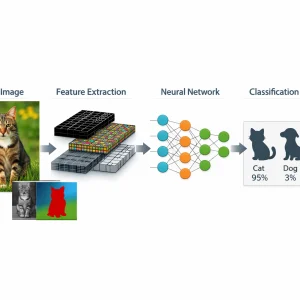
Image recognition is the process of teaching a computer to understand what is inside a picture or a video frame. People do this naturally: you see a dog, a stop sign, or a product logo in a split second. A computer starts with something much simpler, called pixels. Pixels are tiny colored squares, and by themselves they have no meaning. To turn pixels into meaning, image recognition systems use patterns learned from many examples. Modern systems usually rely on machine learning, especially deep learning, which is good at spotting visual patterns like edges, textures, shapes, and colors. In simple terms, image recognition works by looking at an image, finding useful visual signals, comparing them to what it has learned before, and then producing a result such as “cat,” “person,” “car,” or “unsafe content.” The result might also include extra details, like where the object is in the image, how confident the system is, or whether the image contains certain actions or scenes.
Collecting data and preparing images
The first step happens before the computer “learns” anything: collecting a dataset. A dataset is a large set of images that represent what you want the model to recognize. If you want to identify types of plants, you need many plant photos in different lighting, angles, and backgrounds. If you want to detect defects in a factory, you need pictures of normal products and defective ones. Next comes labeling. Labels are the correct answers, such as “rose” or “not rose,” or boxes drawn around objects with names like “helmet” or “forklift.” Good labels matter because the model learns by copying patterns that match the labels. After labeling, teams usually clean and prepare the data. This can include removing duplicates, fixing wrong labels, balancing categories so one class does not dominate, and resizing images to a consistent format. Another key step is data augmentation, which creates more variety by rotating images, changing brightness, cropping, or adding slight noise. Augmentation helps the model handle real-world situations, like blurry camera feeds or shadows. Finally, the dataset is split into training data (for learning), validation data (for tuning settings), and test data (for a fair final check).
Training a model to recognize objects
Training is when a model learns the link between image patterns and labels. Most image recognition today uses convolutional neural networks (CNNs) or related deep learning models, including vision transformers. During training, the model looks at an image and makes a prediction. That prediction is compared to the true label, and the model measures how wrong it was using a “loss” value. Then the model adjusts its internal settings (weights) to reduce that loss. This cycle repeats thousands or millions of times. Over time, early layers learn simple features like edges and corners, and deeper layers learn higher-level features like fur, eyes, wheels, or brand marks. Training also includes choosing the right architecture and settings, such as learning rate, number of layers, and batch size. Many projects save time by using transfer learning, which starts from a model already trained on a huge dataset and then fine-tunes it for a specific task. This is helpful because it reduces the amount of data needed and often improves accuracy. When training is done, developers evaluate the model using metrics such as accuracy, precision, recall, and F1 score. For object detection tasks, they may use metrics like mAP, which checks both correct labels and correct locations of objects.
Inference in the real world
After training, the model is used for inference, which means making predictions on new images it has never seen. Inference can happen on a server in the cloud, on a local computer, or directly on a device like a phone, camera, or edge box in a factory. The typical workflow is: a camera captures an image, the system preprocesses it (resize, normalize colors, maybe crop), the model produces outputs, and then software turns those outputs into actions. For example, in online shopping, inference can tag products, suggest similar items, or let users search with a photo. In security, it can detect an intruder, recognize a face under certain rules, or identify objects left behind. In transportation, it can spot lane markings, traffic signs, and pedestrians. In content moderation, it can flag images that might include violence, nudity, or other restricted content, often sending uncertain cases to a human reviewer. Inference also includes thresholds and confidence scores. A model might say “this is a bicycle” with 92% confidence. A business can decide that anything below, for example, 80% should be double-checked. This is important because a model can be wrong, especially with unusual images, poor lighting, or objects that look alike.
Accuracy, limits, and best practices
Even strong image recognition systems have limits, so it is important to understand what affects performance. Bias can appear when the training data does not represent real users or real environments. For example, a model trained mostly on bright daytime images may struggle at night. A model trained on one country’s road signs may fail in another. Privacy is another major concern, especially with faces, license plates, and personal spaces. Responsible systems should follow local laws, minimize stored personal data, and use security controls such as encryption and access logs. There is also the risk of “false positives” (seeing something that is not there) and “false negatives” (missing something that is there). The best practice is to test in conditions that match reality, monitor results after deployment, and retrain when the environment changes. Many teams also use human-in-the-loop review, where humans check uncertain predictions, and their feedback becomes new training data. For businesses choosing or building image recognition, it helps to define the exact job: classification (what is it), detection (where is it), segmentation (which pixels belong to it), or OCR (what text is in it). Clear goals, high-quality data, careful testing, and ongoing monitoring are what turn image recognition from a demo into a reliable tool that supports real decisions.
Learn more
- Image Recognition Overview
- What is Machine Learning?
- Top 5 Uses of Image Recognition
- Are Machines becoming Smarter than Humans?
- Rising Popularity of Image Recognition
- Image Recognition Trends
- Prevent Crime and Improve Security with Facial Recognition
- Image Recognition in Medical Use
- Image Recognition Software on Cloud Platforms
- Image Recognition is Transforming Business
- Facial Recognition for Brand Awareness
- Image Recognition on Facebook
- Future of Image Recognition
- How Image Recognition is Changing Online Shopping
- How Image Recognition is Improving Online Security
- Image Recognition for Environmental Protection
- How Image Recognition is Enhancing Customer Experience
- How Image Recognition is Enhancing Education
- How Image Recognition Supports Transportation Systems
- How Image Recognition is Streamlining Manufacturing Processes
- How Image Recognition is Helping Agriculture Thrive
- Understanding How Image Recognition Improves Accessibility
- How Image Recognition is Simplifying Everyday Life
- How to Choose Image Recognition Software
- How Image Recognition Helps Content Moderation
- How Image Recognition Works Step by Step
- Image Recognition in Smart Cities
- Image Recognition and Data Privacy
- Benefits of OCR for Modern Businesses